Vendor risk: check a vendor before you sign
Check a vendor before you sign: we read their public site and write the questions that matter.
Before you trust a new tool with your data, you usually send its makers a long security questionnaire and hope for honest answers. Vendor risk does the outside-in part first: give it the vendor’s website, how you’ll use the tool and what you’ll share, and it reads their own public pages, checks every claim they make, and writes the pointed questions that show the real risk. It takes 2 to 5 minutes and runs in the background.
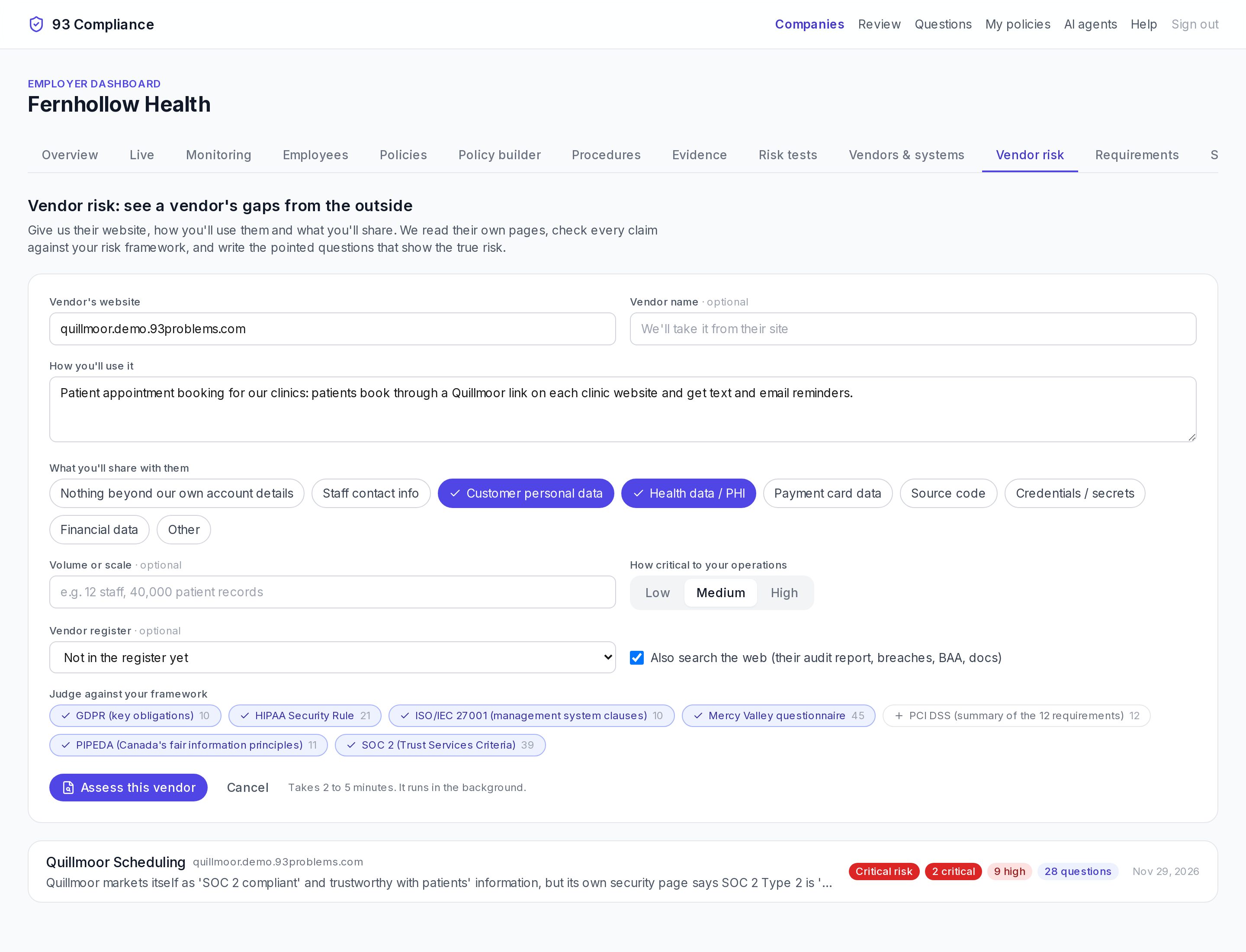
- 1How you’ll use it: who, for what, how much
- 2What you’ll share sets the lowest possible risk tier
- 3Your risk register and requirement sets
- 4Takes 2 to 5 minutes, in the background
Screens show Fernhollow Health, a made-up company we use for demos.
What you tell it
- Vendor’s website, and optionally its name (otherwise it’s taken from their site).
- How you’ll use it, in a sentence or two: who uses it, for what, how much.
- What you’ll share with them: nothing beyond your account details, staff contact info, customer personal data, health data (PHI), payment card data, source code, credentials, financial data, or something else.
- How critical to your operations: low, medium or high. Optional: volume or scale, and the vendor’s row in your vendor register.
- Judge against your framework: your risk register and the requirement sets you test against (SOC 2, HIPAA, a customer’s questionnaire…). The sets that bear on what you’ll share are ticked for you.
- Also search the web (on by default): a few searches for their audit report, breaches, BAA and docs.
How it works
- Reading: their home page, the pages reviewers look for (security, trust, privacy, DPA, subprocessors, pricing, enterprise, status, SLA, security.txt), the links and sitemap entries that matter most, and help articles on SSO, audit logs, retention and encryption last. It reads as 93ComplianceBot and honours their robots.txt.
- Claims: the AI lists what they claim (certifications, controls, contract terms, uptime, named customers, plans) with their exact words. Each quote is checked against the text we fetched, and a quote that isn’t really on their page is dropped.
- Judgement: the claims are weighed against your risk framework and what you’ll share. A step saved as it finishes, so a restart picks up where it stopped.
Low, medium, high or critical. What you share sets a floor: health data, card data, credentials or source code start at high; health data on a highly critical tool is critical. The analysis can raise the tier, with a reason, but never lower it below the floor.
The five kinds of finding
- Contradiction: what they say publicly against what a questionnaire will demand, or one page against another. “HIPAA-ready” on the pricing page but no Business Associate Agreement anywhere. This is the most valuable kind.
- Claim without evidence: “SOC 2 compliant” with no report, auditor, type or period, and no way to ask for it; “bank-grade encryption” with no algorithm.
- Not found: something you’d expect given what you share (a subprocessor list, breach notification terms, SSO) that isn’t on any page read. Absence on a public site isn’t proof, so it says how many pages were checked.
- Weak evidence: an old report, Type 1 only, a scope that leaves out the product you’ll use, a control only on a higher plan.
- Verified: strong public evidence that already answers a requirement. Those questions aren’t asked; they’re listed as already answered.
Each finding has a severity (critical, high, medium, low, info) that reflects your exposure: a missing BAA is critical when you share health data, a missing status page is low for a minor tool. Findings quote the vendor’s own words with a link to the page, and name the requirements of yours they bear on.
The questions
Between 15 and 40 questions, more for higher tiers, each tied to a finding or one of your requirements, grouped by section (Assurance, Health data, Access and identity, Data lifecycle, Subprocessors, Incidents, Availability, AI and our data). They quote the vendor back where that sharpens the question, and ask for evidence rather than reassurance. Each one carries:
- Why we ask: one sentence, written for the vendor.
- Evidence to ask for: the report, clause, screenshot or date to attach.
- A good answer and the Red flag answer that should worry you (for you only).
- Before signing on the ones you need answered before the contract.
A worked example
Quillmoor Scheduling is a made-up booking vendor with a small made-up website, quillmoor.demo.93problems.com, that we use for demos. Fernhollow Health (also made up) wants it for patient appointment booking: patients book through a Quillmoor link and get text and email reminders, so Quillmoor would hold customer personal data and health data (PHI), about 4,000 bookings a month, at medium criticality, judged against Fernhollow’s SOC 2, HIPAA, GDPR, PIPEDA, ISO 27001 and Mercy Valley requirement sets. Web search was off.
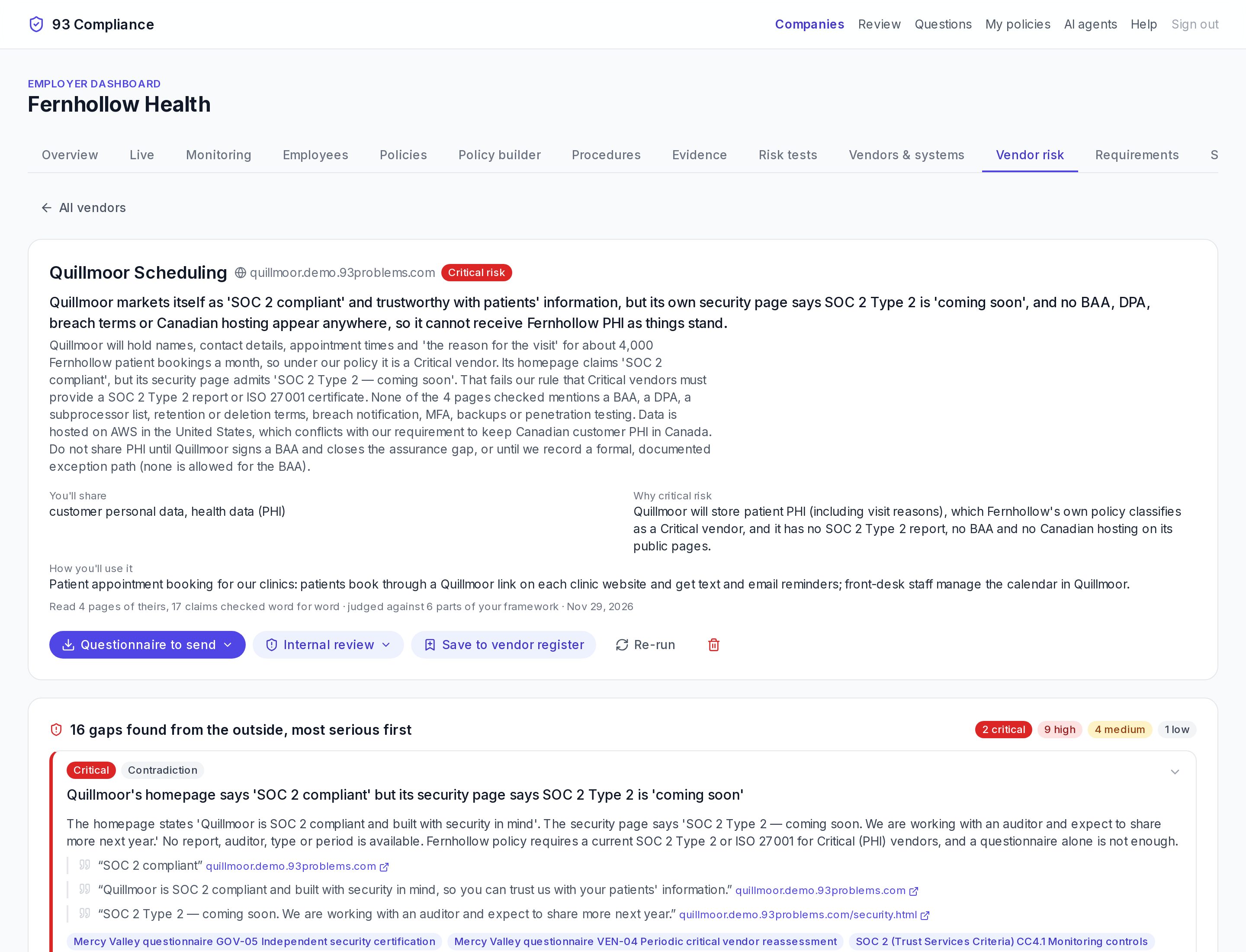
- 1The risk tier, with the reason
- 2Questionnaire to send: questions only
- 3Internal review: findings, good answers, red flags
- 4Link it to the vendor register
- 5Findings, most serious first
Fernhollow’s assessment of Quillmoor Scheduling, a made-up vendor.
It read Quillmoor’s 4 public pages (home, security, privacy, pricing), checked 17 claims word for word, and took under 3 minutes. Health data set a floor of high; the analysis raised it to Critical risk, because Fernhollow’s own vendor policy calls a vendor holding PHI critical and Quillmoor has no report, no BAA and no Canadian hosting on its public pages. 16 gaps (2 critical, 9 high, 4 medium, 1 low) and 1 verified fact:
- Contradiction (critical): the home page says “SOC 2 compliant”, but the security page says “SOC 2 Type 2 — coming soon”.
- Not found (critical): no Business Associate Agreement on any of the 4 pages, although it collects patients’ reason for the visit.
- Contradiction (high): hosted “on Amazon Web Services (AWS) in the United States”, against Fernhollow’s rule that Canadian patients’ PHI stays in Canada.
- Claim without evidence (high): “Bank-grade encryption” and “All data is encrypted”, with no algorithm, TLS version or key management.
- Weak evidence (high): data shared with unnamed “hosting, messaging and analytics providers”, kept “as long as necessary”, and production reached with “strong passwords” and no mention of multi-factor sign-in.
- Weak evidence (medium): SSO and audit logs appear only as Enterprise-plan features (“HIPAA-ready” is on the Clinic plan), with no documentation.
- Verified (info): it names AWS in the United States as its host, so that isn’t asked again.
It wrote 28 questions, 20 needed before signing. The second one quotes Quillmoor back to itself:
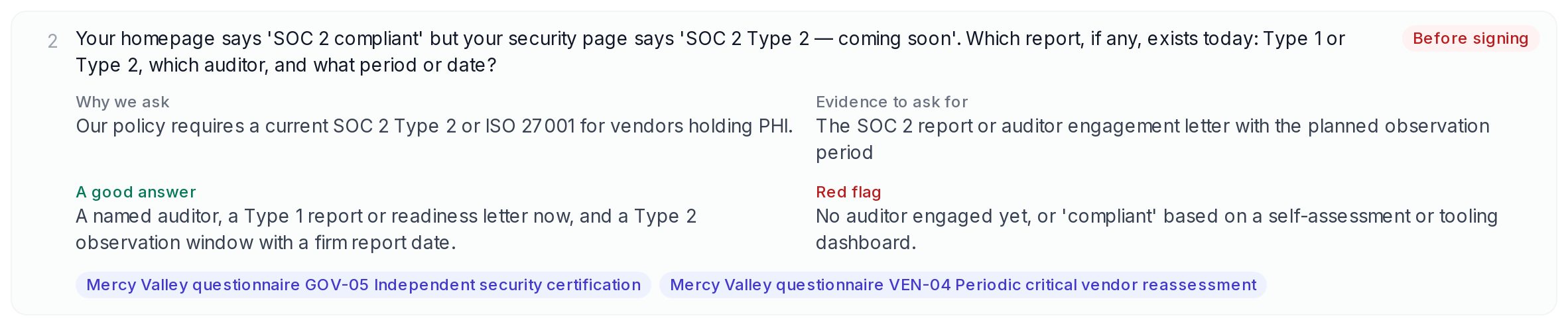
Only the question, why we ask and the evidence go to the vendor; the good answer and red flag stay with you.
Each finding and question names the requirements it bears on (the SOC 2 finding above bears on SOC 2 CC4.1 and two items of the Mercy Valley questionnaire), so the answers feed straight back into your own audit trail.